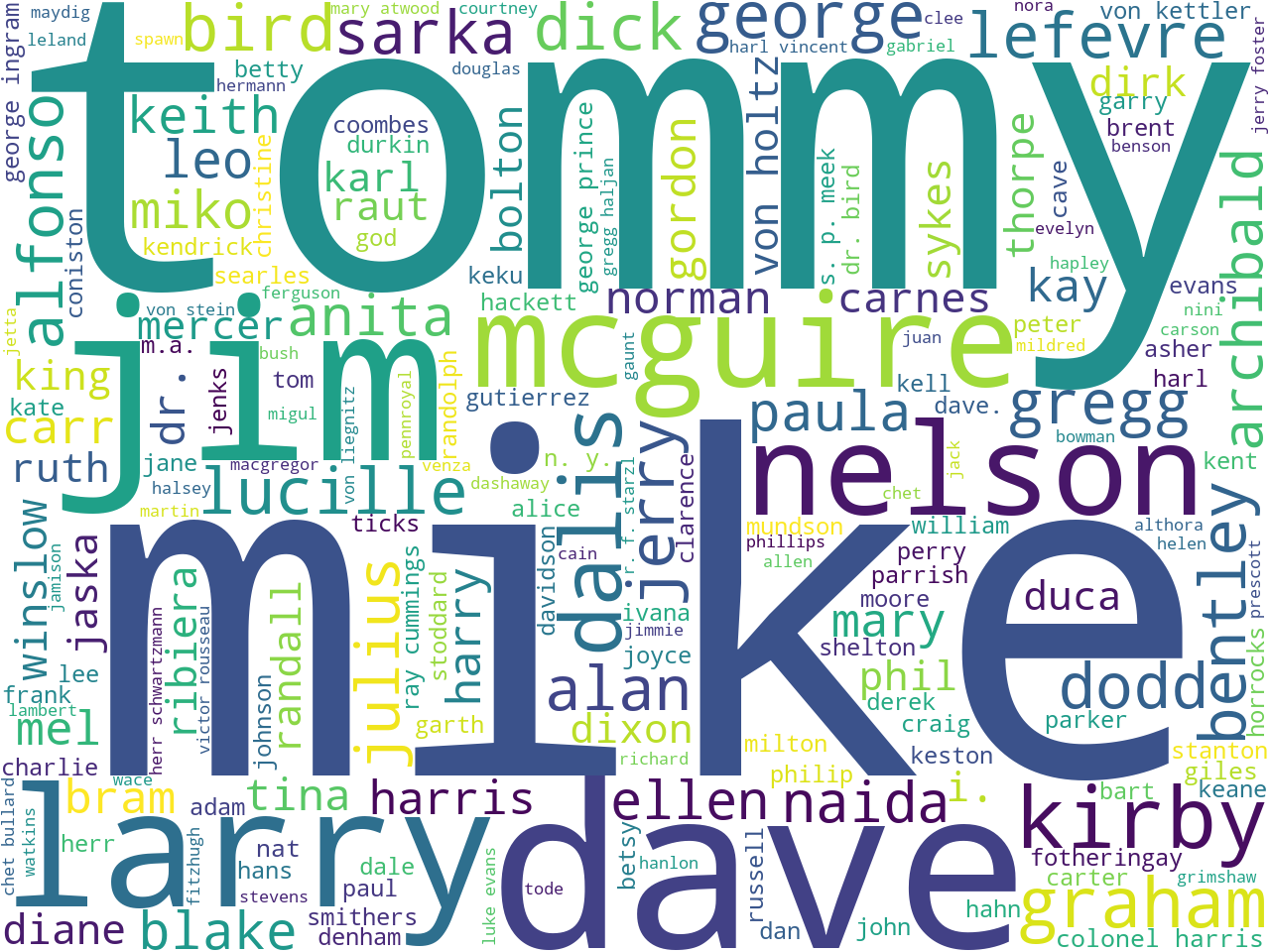
persons
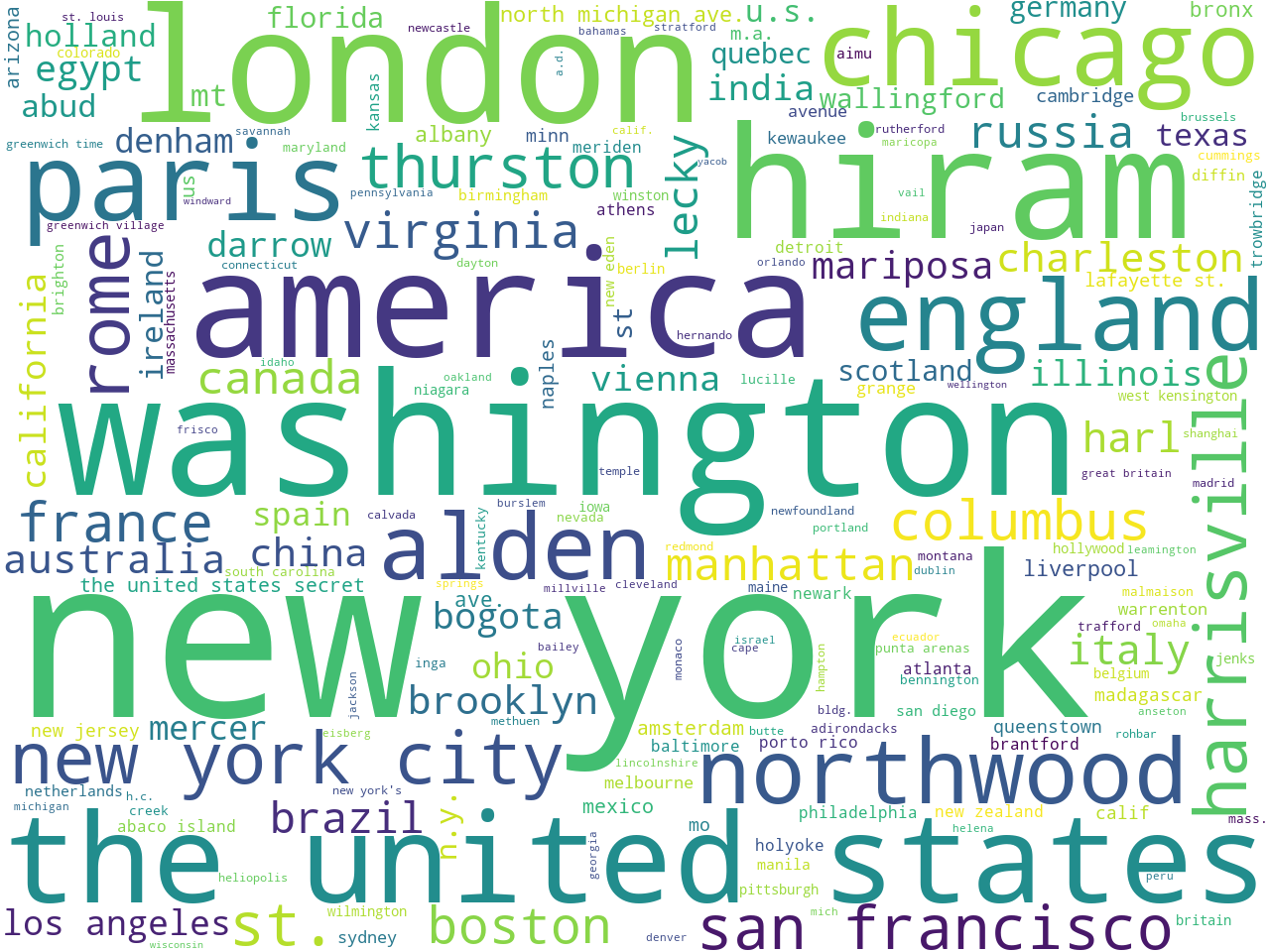
geo-political entities
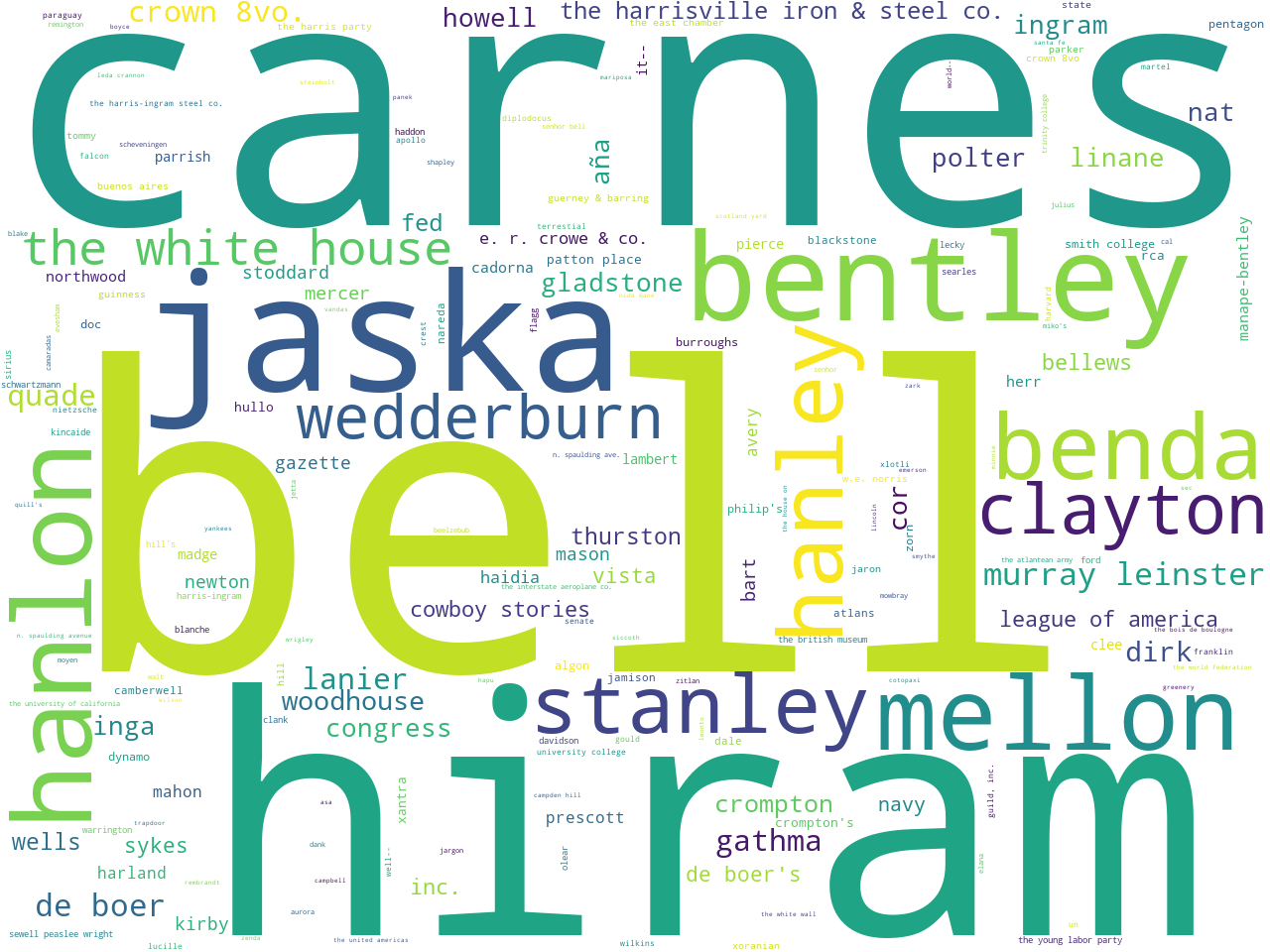
organizations
I used science ficition (sans the fiction) to analyze a collection of... science fiction. Apropo for science fiction, huh? Below is what I gleaned from the process, with a keen interest in learning about intelligence, robots, and what it means to be human.
Below are computer-generated sentences addressing the scope of the science fiction documents as well as rudimentary definitions of what it means to be human, what is intelligence, and what are robots, all rooted in the content of the given study carrel:
The science‑fiction carrel is a compact library of early 20ᵗʰ‑century pulp speculation, tightly woven around human perception, rapid action, and the intersection of emerging technology with familiar urban landscapes. Its lexical fingerprint—rich in personal pronouns, perceptual verbs, and concrete sensory nouns—creates a vivid, immediate reading experience that simultaneously celebrates and interrogates the promises and perils of a rapidly modernizing world.
To be human, as the science‑fiction corpus depicts, is to inhabit a self‑aware, embodied form that blends moral consciousness, social empathy, inquisitive imagination, and awareness of mortality, consistently distinguished from non‑human agents by its capacity for agency, ethical reflection, and the drive to create meaning within a collective, fragile existence.
Intelligence is the dynamic capacity—whether biological, artificial, or collective—to acquire, represent, and manipulate information so that it can recognize patterns, anticipate outcomes, solve problems, adapt to new data, and reflect on its own processes and goals.
Robots are artificial, typically mechanical entities—ranging from simple remote‑controlled devices to sophisticated, self‑aware machines—that embody artificial intelligence (or “intelligence”) and are designed to perform tasks, obey programmed rules (such as the Three Laws of Robotics), perceive and interact with their environment, and, in many of the cited texts, even exhibit learning, self‑reflection, and emotional responses.
Are these things "true"? In my mind, that is not a valid question. Instead, I use the things outlined above as pointers to the truth; the are concepts to keep in mind as the analysis continues.
Below are the MCP-generated descriptions of the carrel's bibliography, part-of-speech words, named-entity words, and "interesting" (keywords, unigram, and bigram) words.
Again, are the results "true". I don't know, exactly, but based on my experience, they are very very plausible.
| Element | Detail (derived from the carrel’s bibliography) |
|---|---|
| Time span | Works date from the late‑19ᵗʰ century through the early 1930 s, a period when the “Super‑Science” pulp boom was at its height. |
| Item count | Approximately 55 distinct items (novels, short‑story collections, and stand‑alone magazine issues). |
| Word‑count total | Roughly 2 million words, with most individual items ranging between 30 k–90 k words. |
| Readability | Flesch scores cluster between 71 and 89, indicating prose that is deliberately brisk and accessible to a mass audience. |
| Authorship | Dominated by a handful of prolific pulp writers (e.g., Murray Leinster, E. Everett Evans, H. G. Wells) together with many anonymous or pseudonymous contributors common to early magazine culture. |
| Typical titles | “Man of Many Minds,” “The Memory of Mars,” “The Success Machine,” and a series of “Astounding Stories of Super‑Science” issues—titles that foreground person, place, or technology as the primary hook. |
| Category | Most frequent entries (counts) | Interpretive note |
|---|---|---|
| People / characters | Mike (670), Tommy (589), Dave (561), Jim (533), Larry (524) | A small, recognizable cast of “every‑man” protagonists—typical of serialized adventure. |
| Organizations | Bell (225), Carnes (180), Hiram (162), Jaska (158), Bentley (127) | Corporate‑sounding names that signal labs, telecommunications firms, or secret societies—common antagonists or allies in speculative narratives. |
| Places | New York (409), Washington (206), London (183), Hiram (171), America (159) | Urban centres dominate, especially U.S. metropolises, indicating a worldview anchored in contemporary industrial hubs while also inventing fictional locales (Hiram). |
persons |
geo-political entities |
organizations |
| POS | High‑frequency items (top 5–7) | What they reveal |
|---|---|---|
| Nouns | man (5 064), world (2 865), room (2 480), time (2 374), hand (2 250), space (2 174) | Human agents and the spaces they inhabit are the core focus; “world” and “space” signal the genre’s outward‑looking ambition. |
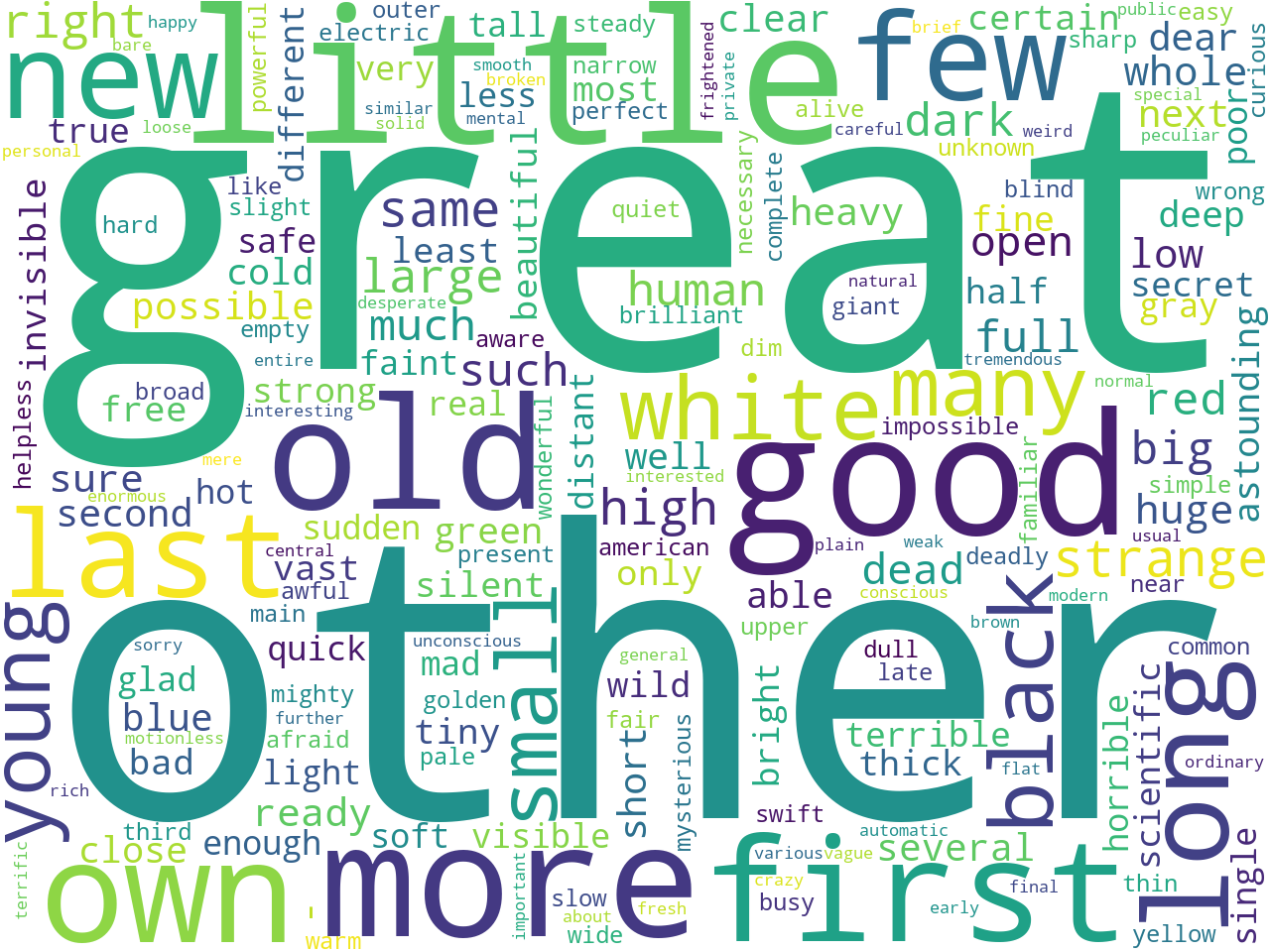
| Adjectives | great (1 975), strange (1 931), old (1 815), new (1 765), little (1 541), dark (1 479) | A tension between the familiar (old, great) and the uncanny (strange, dark). The adjective human (923) re‑asserts the centrality of humanity amid exotic settings. |
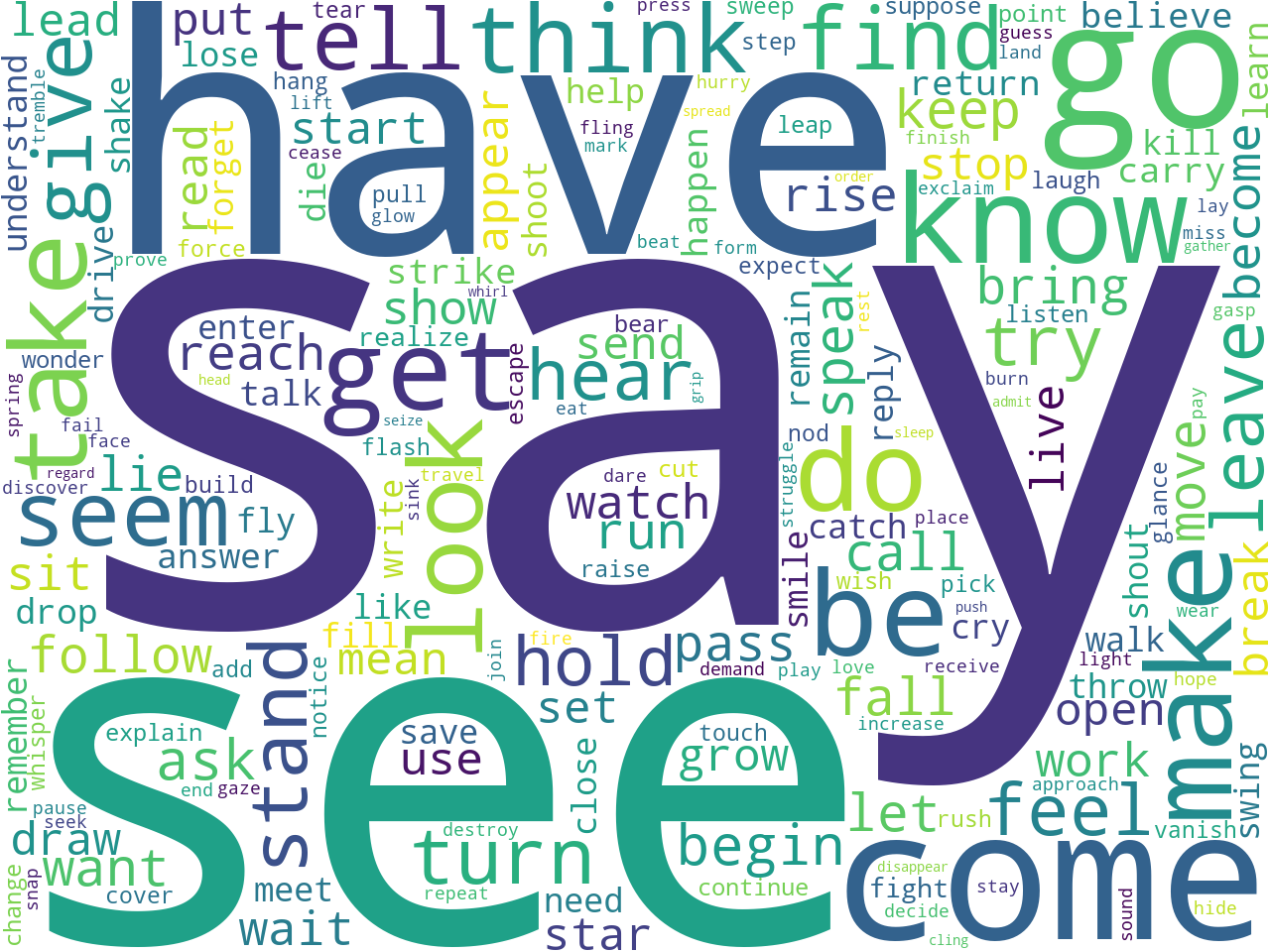
| Verbs | say (9 443), see (7 762), have (7 628), come (7 318), go (6 921), know (5 533), make (5 047) | Communication, perception, and movement dominate; verbs of discovery (see, know, think) sit alongside action verbs (go, make, take), underscoring a narrative rhythm of observation → decision → motion. |
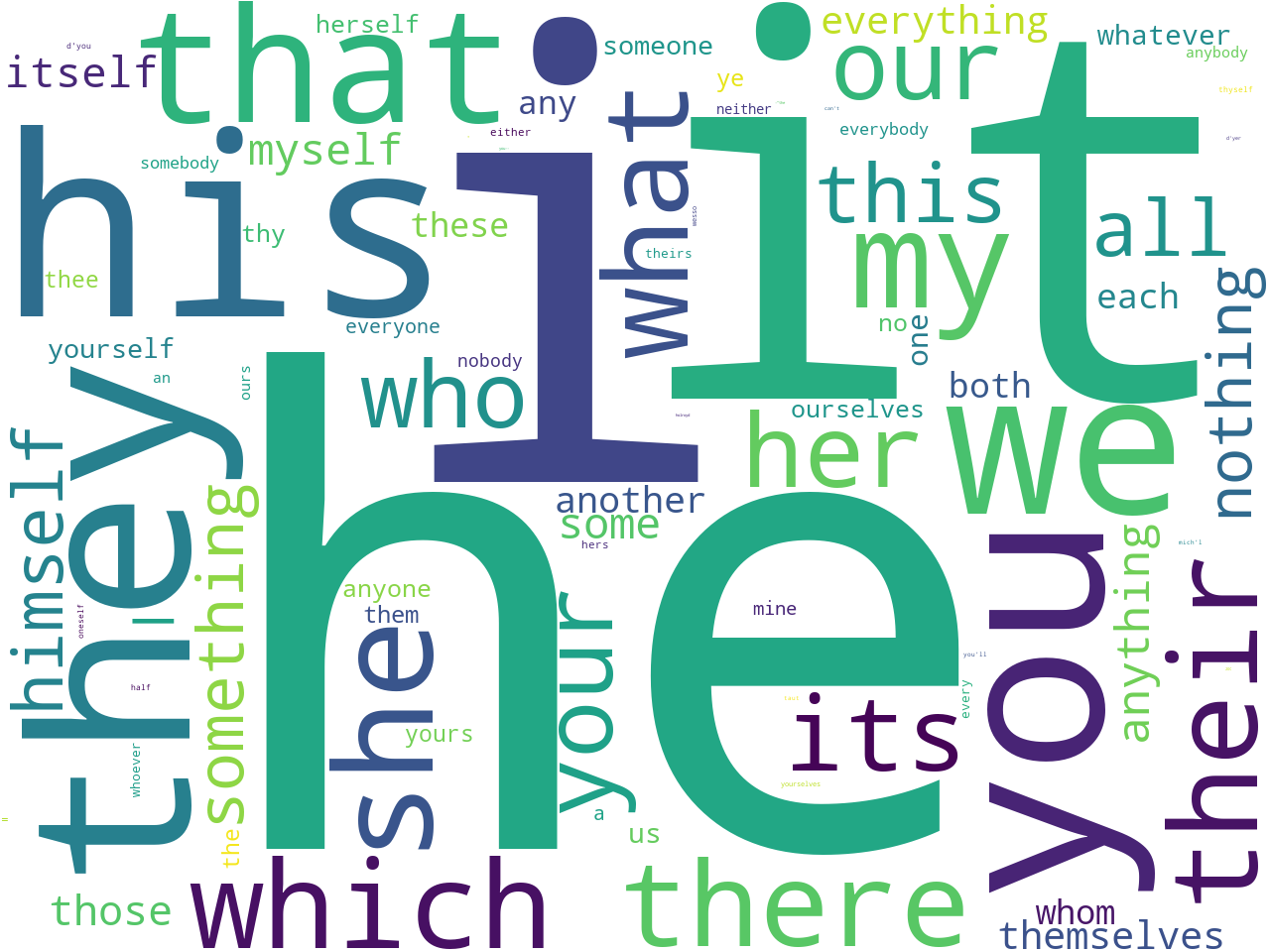
| Pronouns | he (34 k), I (34 k), you (17 k) | Persistent shifts between third‑person narration, first‑person immersion, and direct reader address – a hallmark of pulp storytelling. |
Implication: The POS distribution paints a picture of fast, dialogue‑heavy prose where characters constantly see, think, and act within confined but technologically saturated settings.
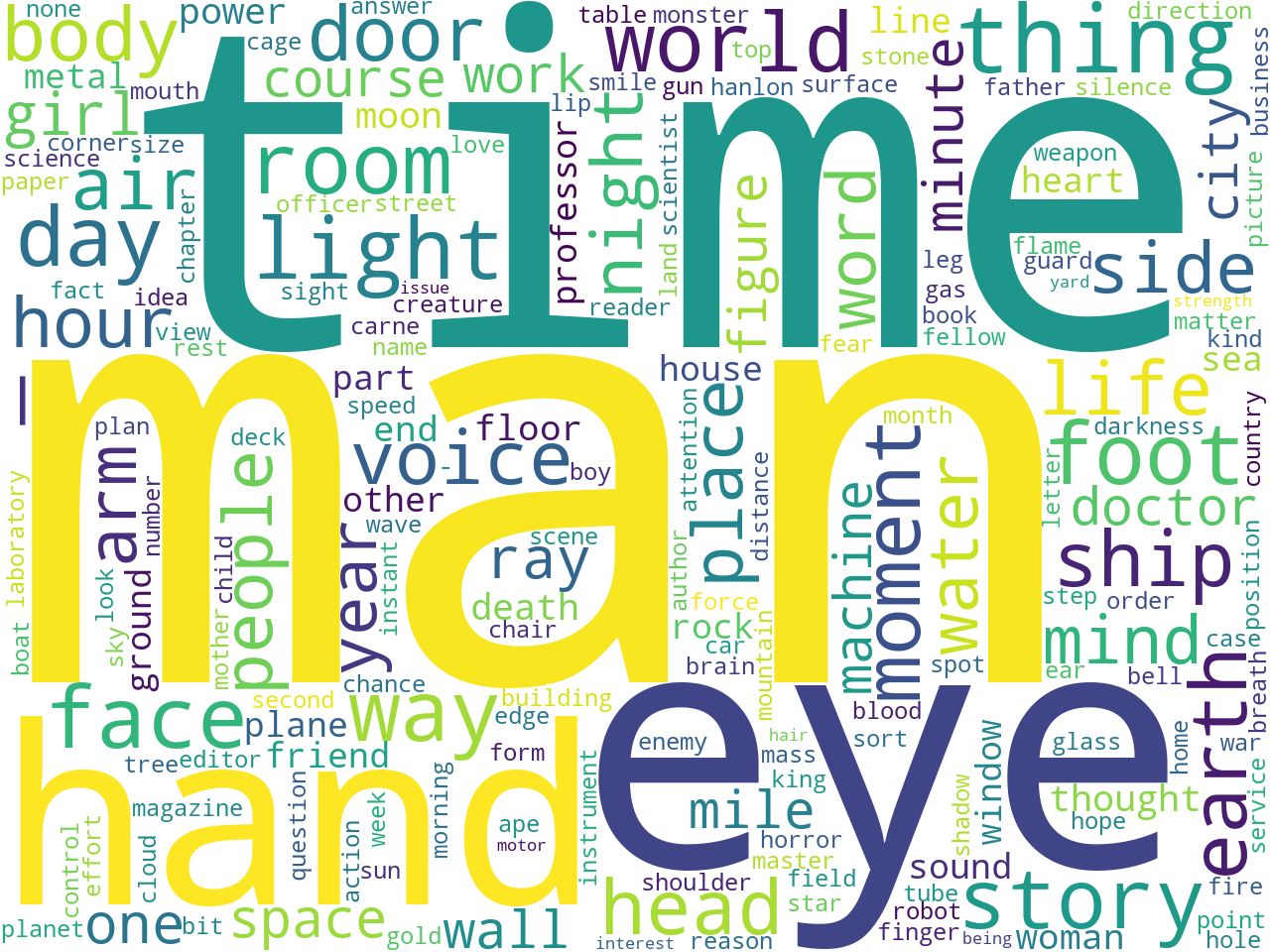 nouns |
 pronouns |
 verbs |
 adjectives adjectives |
| Bigrams (≈ frequency) | Narrative function |
|---|---|
| I think / I saw / he saw / I know | Immediate internal commentary; audience is kept inside the character’s mind. |
| you know / you must / you can | Direct address that pulls the reader into the adventure. |
| space ship / alien world / scientific knowledge | Core sci‑fi tropes establishing technology and otherness. |
| hand reached / hand turned / hand held | Emphasis on tactile interaction with controls, weapons, or artifacts. |
| must go / must find / must stay | Mission‑driven urgency. |
| light turned / light shone / light flashed | Visual triggers marking plot twists or revelations. |
| ground fell / wall opened / door opened | Sudden environmental changes that propel suspense. |
Takeaway: The bigrams reveal a repetitive, formulaic scaffolding: perception → warning → action → obstacle → resolution, all delivered in an engaging, second‑person voice.
 unigrams unigrams |
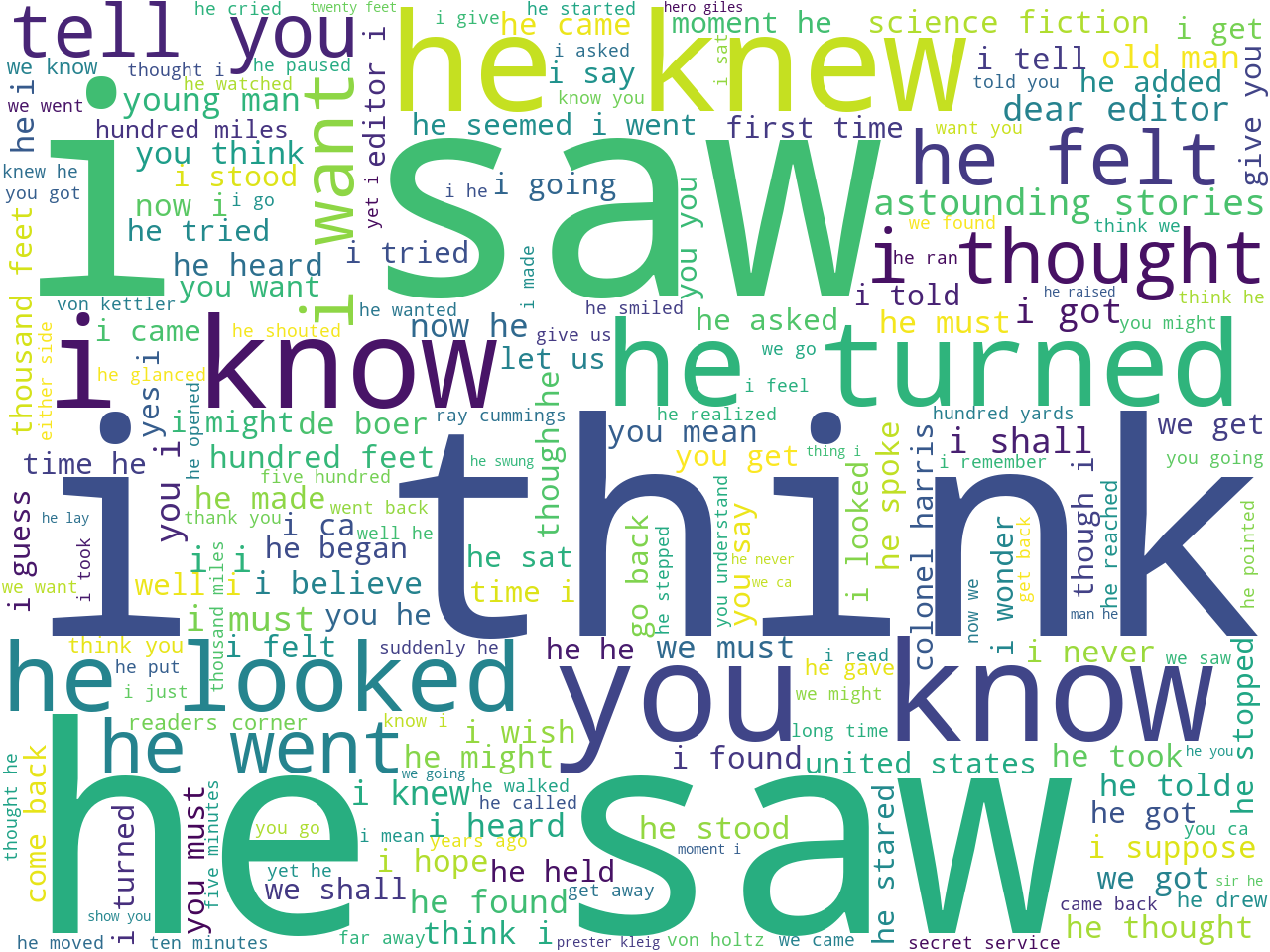 bigrams bigrams |
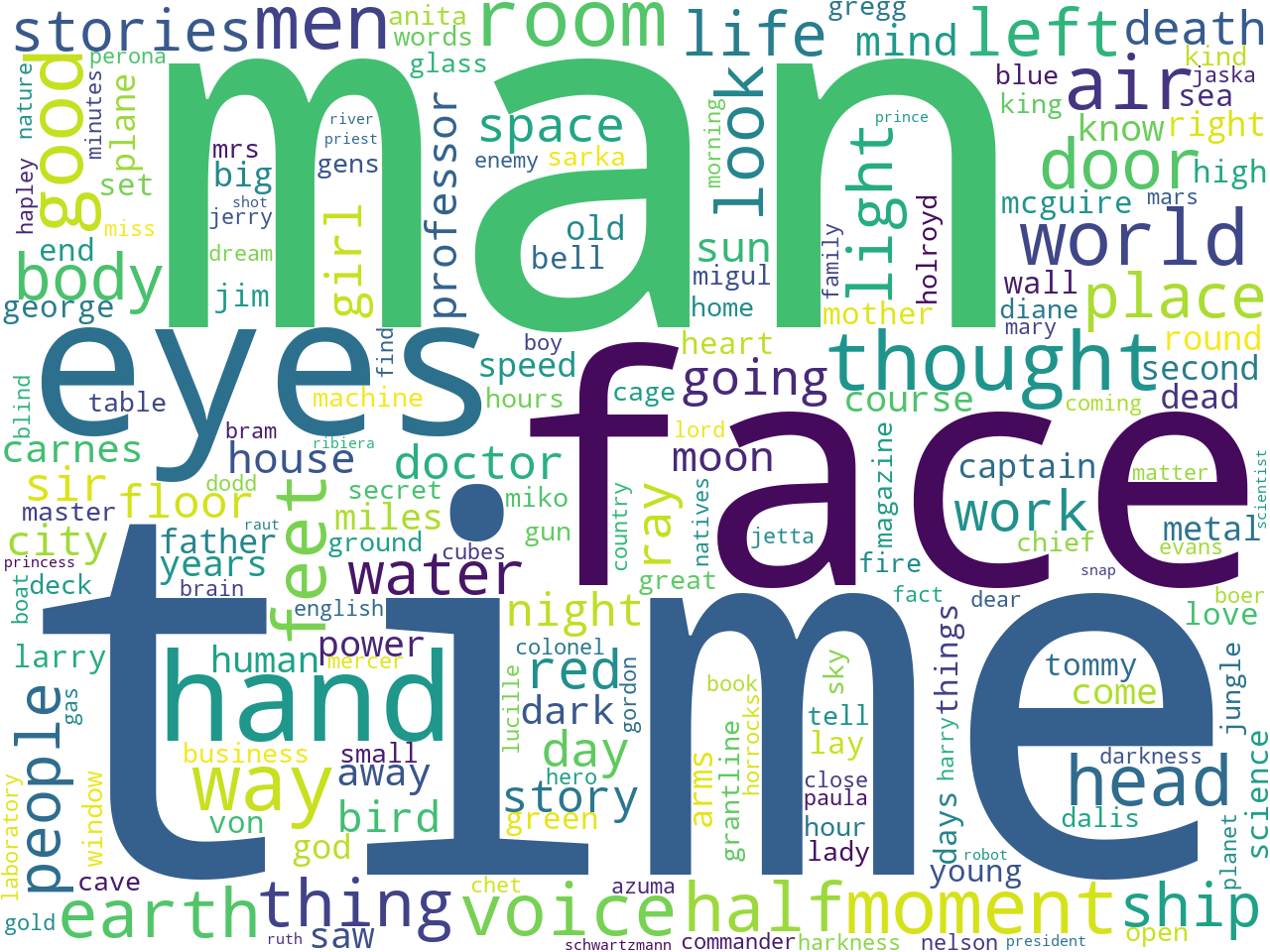 keywords keywords |
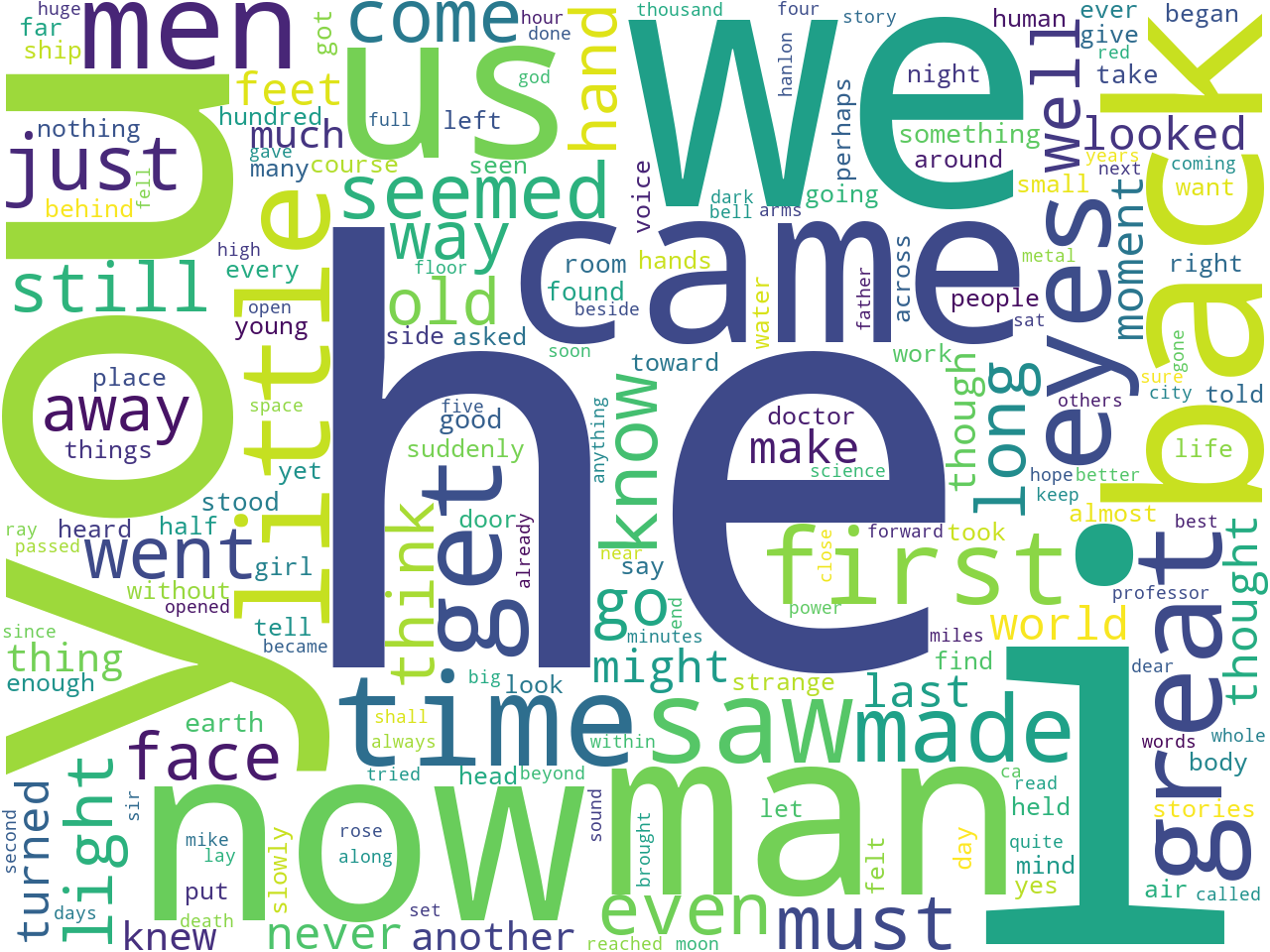
Human agents in extraordinary milieus – The sheer volume of man, eyes, hand, face alongside world, space, planet shows that the carrel’s stories constantly re‑anchor alien or futuristic settings to the body and mind of the protagonist.
Perception‑driven narrative rhythm – The alignment of high‑frequency verbs (see, think, know) with pronoun usage (I, he, you) and bigrams like I think suggests a storytelling pattern where observation triggers decision‑making, which then leads to decisive action (must go, must find).
Technological and elemental tension – Keywords and adjectives (light, dark, red, blue, strange, great) together with nouns (machine, ship, laboratory) articulate a constant contrast between order (technology, science) and chaos (unknown colors, darkness, elemental forces).
Urban and corporate framing – Frequent place names (New York, Washington, London) and organization names (Bell, Carnes) ground the speculative narratives in recognizable power structures, hinting that many plots explore the impact of emerging industrial and communication technologies on everyday life.
Pulp‑style voice – Direct address (you know, you must), high verb counts, and low Flesch scores collectively produce the brisk, conversational tone that characterizes early 20ᵗʰ‑century adventure magazines.
Thematic preoccupations – Recurrent mentions of time, death, light, and space point to three overarching concerns: the passage and manipulation of time, the threat of mortality in hostile environments, and the illumination (literal or metaphorical) of hidden truths.
The curated‑apropoForScienceFiction‑gutenberg collection treats “intelligence” chiefly as a quantifiable, institutional asset. In “Astounding Stories, July 1931” (index 3733) a character remarks on “a high degree of intelligence” possessed by an alien contrivance, while “Astounding Stories of Super‑Science, October 1930” (index 925) reduces the term to a bureaucratic label—“Intelligence was alert”—and later to an official body (“Eastern Intelligence District”, index 1238). Similar bureaucratic overtones appear in “A Republic Without a President, and Other Stories” (index 861), where an operative is dismissed because “no intelligence came from Russell,” and in “Man of Many Minds” (index 2740), where a “master machine intelligence” governs an entire Martian fleet (index 340). Across these titles the word is repeatedly paired with testing, ranking, and command structures, reflecting early‑20th‑century worries that scientific and administrative systems might codify and weaponize cognition.
A second, more literary strand uses “intelligence” as a marker of personal merit or moral quality. “The Stolen Bacillus and Other Incidents” (index 1339) and “The Door in the Wall, and Other Stories” (index 1642) both note “a quality of intelligence in his forehead and eyes,” while “The World of H. G. Wells” (index 1093) equates intelligence with the capacity for “intellectual curiosity.” Yet the tone is ambivalent: “The Harris‑Ingram Experiment” (index 3632) warns that “limited intelligence” can hamper a hero, and “Master of His Fate” (index 248) boasts, “My brain, my intelligence, has made me master of the world!” In “Unwise Child” (index 1267) the narrator self‑corrects, preferring “living intelligence,” underscoring how the term oscillates between admiration and critique. Together, these examples reveal a recurring pattern in the anthology: intelligence is celebrated as the source of insight and power, yet simultaneously cast as a potential source of hubris, surveillance, and the uncanny when transferred to machines or alien societies.
Across the collection, “intelligence” shifts between a measurable, bureaucratic or machine‑driven force—often tied to secret services, tests, and autonomous systems—and a personal, moral quality that signals insight, competence, or hubristic superiority.
The collection of stories in curated‑apropoForScienceFiction‑gutenberg yields just over a hundred occurrences of the word human. Across forty‑eight distinct works, the term appears most frequently in the serialized adventure “Man of Many Minds” (e.g., index 1526 – “Was the guy human—or did he have a mind‑control of some sort?”; index 3558 – “We know now that Gorth Bohr wasn’t human—he was an alien…”) and in several issues of Astounding Stories (e.g., index 225 – “The human figure slipped through the doorway”; index 591 – “Human nature is very strange”). In the short tale “The Harris‑Ingram Experiment” a solitary line (index 3406) simply declares, “George and his wife were human, and not unlike other people,” while the early pulp “Unwise Child” offers a striking contrast (index 1,245) with “Human friends, a limited number had a future.” The repeated pairing of human with descriptors such as “robotic,” “ape,” “alien,” and “augmented” underscores the genre’s preoccupation with the boundary between the familiar flesh and speculative otherness.
Two dominant themes emerge. First, human functions as a benchmark against which technology and non‑human intelligences are measured; the language of the period treats the term as a convenient reference point for readers navigating exotic beings (“human body could be used as a bullet,” index 4,131 in Astounding Stories). Second, the stories repeatedly interrogate the essence of humanity—its emotions, morality, and destiny—through questions and statements that pit the species against itself (“What is a human being?” in index 2,103 of “Man of Many Minds”; “The futile plans of humans!” in index 772 of Astounding Stories). This binary framing invites a broader philosophical reflection on the human condition that reverberates from early twentieth‑century pulp to today’s AI debates.
Taken together, the indexed citations reveal a corpus in which the adjective human serves both as a narrative anchor and as a catalyst for speculative inquiry. By cataloguing the specific story titles and index numbers—Man of Many Minds (1526, 3558, 4183, etc.), Astounding Stories (225, 591, 772, 1,245), The Harris‑Ingram Experiment (3,406), Unwise Child (1,245)—the analysis maps a pattern: writers repeatedly ask what differentiates the flesh‑bound, fallible human from the engineered, the alien, or the future self, providing a fertile ground for liberal‑arts exploration of identity, technology, and ethical imagination.
Eric Lease Morgan <eric_morgan@infomotions.com>
June 1, 2026